
Heat Treated Pallets: Which Shipments Need Them
Heat treated pallets are wood pallets heated to a 56°C core temperature for at least 30 minutes, then permanently marked. We field this question far more often than shipments call for it. Where your load crosses the border decides the answer, and many lanes running out of our Chesterfield yard need nothing at all.
Key Highlights
- Heat treatment requires a 56°C core temperature held for at least 30 consecutive minutes
- ISPM 15 regulates skids, crating, dunnage and packing blocks alongside pallets
- Wood under 6mm thick and manufactured wood products fall outside the standard
- Shipments between the continental US and Canada are exempt when the documents state where the wood originated
- Loads to Mexico and most overseas destinations need treated pallets carrying the IPPC mark
| Where the load is going | Does the pallet need heat treatment | What the paperwork has to say |
|---|---|---|
| Within the United States | No | Nothing required |
| United States to Canada | No, if the wood originated in the continental US or Canada | Must state the wood packaging originated in the Continental US |
| Canada to United States | No, under the same bilateral exemption | Must state the wood packaging originated in Canada |
| United States to Mexico | Yes | Treated and marked with the IPPC mark |
| US mainland to Hawaii, Puerto Rico, US territories | Yes | Exemption does not extend past the continental US |
| Anywhere overseas | Yes, for most destinations | Treated and marked with the IPPC mark |
When a shipment needs heat treated pallets
The destination decides whether a pallet needs treatment. A skid of machine parts and a skid of canned soup follow the same rule, because the standard targets wood-boring pests rather than anything in the cargo.
Domestic freight is the easy case. Wood packaging moving between two points inside the United States sits outside ISPM 15, so an untreated pallet does the job.
Canada trips people up in both directions. An exemption has been in place since 2005 covering wood packaging made from timber that originated in the continental United States or Canada, and using it costs nothing. The catch is paperwork. USDA APHIS requires the import documents to carry a statement that the wood packaging originated in the Continental US, or in Canada for freight heading the other way.
Say you run weekly loads from Missouri into Ontario on pallets built from US lumber. Those pallets qualify, and the exemption saves you the treatment cost on every truck that leaves. Leave the origin statement off the bill of lading and a border officer has no way to tell your wood from anyone else's.
Mexico works the other way. The southern border is a full ISPM 15 border, and the exemption you rely on for Ontario does nothing for you in Laredo.
Do pallets need to be heat treated to ship to Canada?
Usually no. Canada and the United States exempt wood packaging built from timber that originated in the continental United States or Canada. To claim the exemption, your shipping documents must say so in those terms. Without that statement, the pallets need treatment and a visible IPPC mark.
Do I need ISPM 15 pallets for Mexico?
Yes. USDA APHIS lists Mexico among the countries requiring ISPM 15 compliance, and Mexico implements the standard through NOM-144-SEMARNAT. Pallets, skids and dunnage heading south need heat treatment or fumigation plus a legible mark. The bilateral exemption stops at the southern border.
Do domestic US shipments need heat treated pallets?
Domestic freight is exempt. ISPM 15 governs international movement, so a load running from Missouri to Texas needs no treatment and no mark. Shipments to Hawaii, Puerto Rico and US territories are the exception, since they sit outside the continental exemption and do need marked wood packaging.
Which wood packaging ISPM 15 covers
ISPM 15 covers more than the pallet under your load. US Customs and Border Protection defines regulated material as wood used for supporting, protecting, or carrying cargo, which pulls in dunnage, crating, packing blocks, drums, cases and skids.
That breadth is where shippers get caught. A marked pallet carrying untreated bracing lumber is still a non-compliant shipment, and the bracing is the part nobody thinks to check.
Two categories sit outside the standard: wood under 6mm thick in any dimension, and manufactured wood products such as plywood or oriented strand board.
What is the difference between a pallet and a skid?
A pallet has top and bottom deck boards. A skid has only a top deck, which makes it lighter and easier to drag but less stable in racking. Under ISPM 15 the distinction means nothing. Both are solid wood packaging, and both need treating on the same lanes.
If you are choosing between formats for a specific load, pallet dimensions matter more to your racking and your truck fill than they do to your compliance position.
What USMCA requires for pallets
USMCA sets no requirement for pallets. The agreement carries no pallet standard and no certification a wood skid could be built to satisfy. US law implementing the agreement states that packing materials and containers for shipment are disregarded in determining whether a good is originating, so the pallet under your freight has no bearing on your origin claim.
Buyers who ask us about USMCA compliance usually mean something else. They want to know whether their cross-border loads need treated wood, and ISPM 15 answers that question. The trade agreement governs the goods. The phytosanitary standard governs the wood underneath them.
How to read the IPPC mark on a pallet
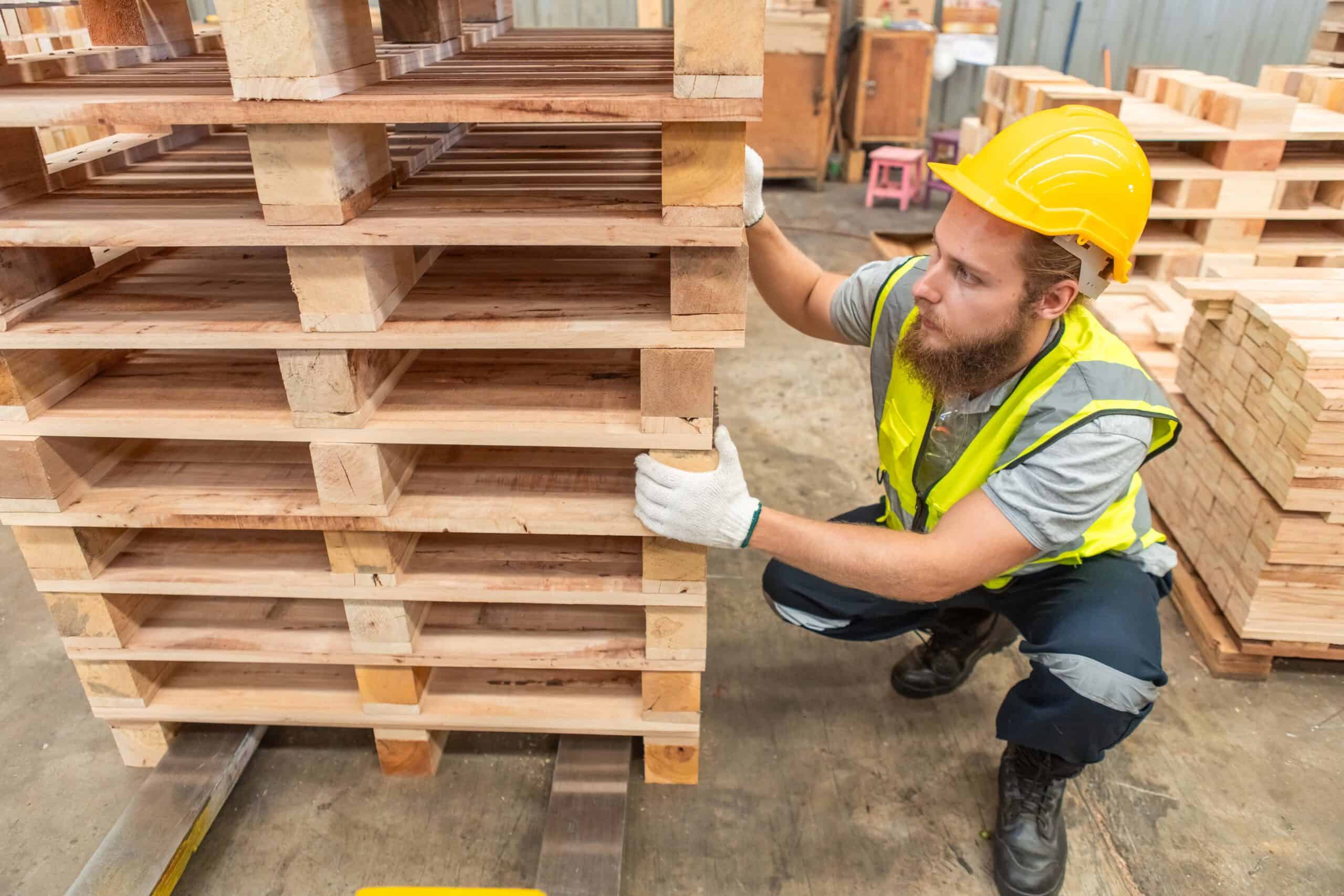
The IPPC mark tells an inspector three things: the country that treated the wood, the facility that performed the treatment, and the method used. HT means heat treatment. MB means methyl bromide fumigation.
A pallet with no legible mark counts as untreated, whatever its history. The Canadian Food Inspection Agency warns that removing or obscuring marks can lead US authorities to treat the wood as non-compliant, which means a genuinely treated pallet can fail on a sanded-down stamp alone.
Red flags: when checking incoming wood packaging
- A mark that is smudged, painted over or sanded down
- A repaired pallet carrying its original mark alongside newly fitted boards
- Visible live pests, soil or weed seeds on the packaging
If you are not sure which of your lanes need treated, marked pallets, send us your destinations and load specs and we will tell you which ones do.
Check your lanes with our teamWe will tell you if the answer is none of them.
What happens when a pallet fails inspection
The load stops moving. Wood packaging that arrives unmarked, or with a mark an officer cannot read, gets handled as non-compliant, and the shipment waits while the packaging problem is resolved rather than while anyone examines your product.
Time is the expensive part. Demurrage and detention accrue against a container that is sitting still, and the delivery date you promised a customer moves whether or not the cargo was ever the issue. A single untreated skid in a mixed load is enough to hold everything behind it.
Border risk and road risk are separate problems, and protecting a load in transit is its own discipline with its own failure points.
Heat treatment compared with the alternatives
Heat treatment is one of three approved methods. US Customs and Border Protection recognises heat treatment, methyl bromide fumigation and dielectric heating, and in our experience US shippers meet heat treatment far more often than either alternative.
A second route sidesteps treatment altogether. Because manufactured wood products sit outside ISPM 15, packaging built entirely from plywood or engineered panels needs no treatment and no mark. The trade-off lands on capacity and cost, and the arithmetic only works for lighter loads.
Mixed construction removes that advantage. A pallet combining engineered components with solid wood deck boards still contains regulated solid wood, so the exemption covers only packaging built wholly from manufactured material. Buyers who assume a hybrid pallet is automatically exempt tend to find that out at a border rather than at a desk.
Key Takeaways
- Heat treatment means a 56°C core temperature held for at least 30 consecutive minutes, then a permanent IPPC mark
- ISPM 15 covers skids, crating, dunnage and packing blocks, not only pallets
- Continental US and Canada shipments are exempt with the right statement on the shipping documents, while Mexico and overseas shipments are not
- USMCA sets no pallet requirement and the pallet has no effect on a shipment's origin claim
Tell us where your loads go and we will spec the pallet to match, treated where it has to be and standard where it does not.
Get a pallet spec for your lanesFrequently Asked Questions
Ready to Upgrade Your Pallet Strategy?
Whether you're looking for custom pallets, sustainable solutions, or just better pricing - we're here to help.